The Telemetry Pipeline
eDR-Graph processes endpoint telemetry through a 7-stage pipeline, from raw OS events to automated response actions. Each stage is designed for a specific job, and the ordering is critical for both performance and correctness.
Pipeline Diagram
┌─────────────┐   ┌──────────────┐   ┌──────────────┐   ┌──────────────┐
│  Collectors  │──▶│  Normalizer  │──▶│  Processor   │──▶│  Graph DB    │
│  (per-OS)   │   │  (OCSF)      │   │  (entities + │   │  (Kuzu)      │
└─────────────┘   └──────────────┘   │   fast-path)  │   └──────┬───────┘
      │                               └──────┬───────┘          │
      ▼                                      │ (blocked)        ▼
┌─────────────┐   ┌──────────────────────────┼───────────────────────────┐
│  SQLite     │   │                 LLM Analyzer                         │
│  Queue      │   │  ┌──────────┐  ┌───────────┐  ┌──────────────────┐  │
│  + Findings │   │  │ Preflight│─▶│ Tool-Use  │─▶│ Finding Builder  │  │
│  + Audit    │   │  │ (novelty)│  │ Loop (5x) │  │ + Chain Context  │  │
└─────────────┘   │  └──────────┘  └───────────┘  └──────────────────┘  │
                  └──────────────────────────────────────────────────────┘
                                        │
                                        ▼
┌───────────────────────────────────────────────────────────────────────┐
│                      Response Engine  ◀── fast-path (skip LLM)        │
│  Severity ──▶ Baseline/Allow/Block ──▶ Approval ──▶ Execute ──▶ Audit │
└───────────────────────────────────────────────────────────────────────┘
Stage 1: Collection
Platform-native collectors gather raw telemetry events and push them to the SQLite event queue.
| Platform | Collectors |
|---|---|
| Linux | eBPF (execve, connect syscalls), auditd, journald, syslog, psutil |
| macOS | Unified Log, FSEvents, DNS interception (tcpdump), persistence polling, connection metadata (tcpdump SYN), psutil |
| Windows | ETW (kernel process/network/file/DNS/registry), Event Log (Security/System/Sysmon), psutil |
| Cross-platform | psutil (process + network polling), TLS SNI extraction, JA3 fingerprinting |
eBPF startup probe (Linux): At startup, the agent attempts to load an eBPF collector. If BPF loads successfully, psutil switches to snapshot_only=True mode — the first collect() call emits all current process state, and subsequent calls return []. This prevents duplicate events when eBPF is handling real-time collection.
Collector thread: Runs in a daemon thread, polling at collector.poll_interval (default: 1s). Raw events are serialized to JSON and pushed to the SQLite queue in batches.
Stage 2: Normalization
Raw events from different OS sources are standardized to OCSF (Open Cybersecurity Schema Framework) event classes.
6 OCSF event types:
| OCSF Class | Description |
|---|---|
ProcessActivity |
Process creation, termination, signals |
NetworkActivity |
TCP/UDP connections, listening sockets |
DnsActivity |
DNS queries and resolutions |
FileActivity |
File create, read, modify, delete |
RegistryActivity |
Windows registry key operations |
Authentication |
Login events (SSH, local, AD) |
~30 source → normalizer mappings route each raw event source to the correct normalizer function. For example:
psutil_process→normalize_processebpf_execve→normalize_processetw_dns→normalize_dnsconnection_metadata→normalize_network
Events that cannot be normalized are silently dropped with a counter metric (edr_events_dropped_total{reason="normalization_returned_none"}).
Stage 3: Entity Extraction
Normalized OCSF events are decomposed into graph entities (nodes) and relationships (edges).
6 node types:
| Node | Key Properties |
|---|---|
User |
id, name, uid |
Process |
id, name, pid, cmd_line, exe_path, hostname, parent_pid, code_signed, signing_authority |
IP |
id, address, is_private, country, isp, asn, classification |
Domain |
id, name, is_dga_candidate, tld |
File |
id, path, hash_sha256, size |
RegistryKey |
id, path, value_name, value_data |
12+ relationship types:
(:User)-[:SPAWNED]->(:Process)
(:Process)-[:CONNECTED_TO]->(:IP)
(:Process)-[:RESOLVED]->(:Domain)
(:Domain)-[:RESOLVES_TO]->(:IP)
(:Process)-[:CREATED_FILE]->(:File)
(:Process)-[:MODIFIED_FILE]->(:File)
(:Process)-[:READ_FILE]->(:File)
(:Process)-[:DELETED_FILE]->(:File)
(:Process)-[:CREATED_REG]->(:RegistryKey)
(:Process)-[:MODIFIED_REG]->(:RegistryKey)
(:Process)-[:DELETED_REG]->(:RegistryKey)
(:Process)-[:LISTENING_ON]->(:IP)
Process node ID format: {hostname}:{pid}:{create_time_epoch} — guarantees uniqueness even across PID reuse.
Enrichment during extraction:
- Parent PID resolution via psutil (cached per PID)
- User identity resolution (OCSF actor → psutil fallback → UID map)
- Code signing verification (macOS: Apple certificate chain validation)
- DGA detection on DNS domains (entropy analysis, consonant-vowel ratios, bigram frequency)
- Persistence detection on file/registry events (LaunchAgent/Daemon, Run keys, cron/systemd)
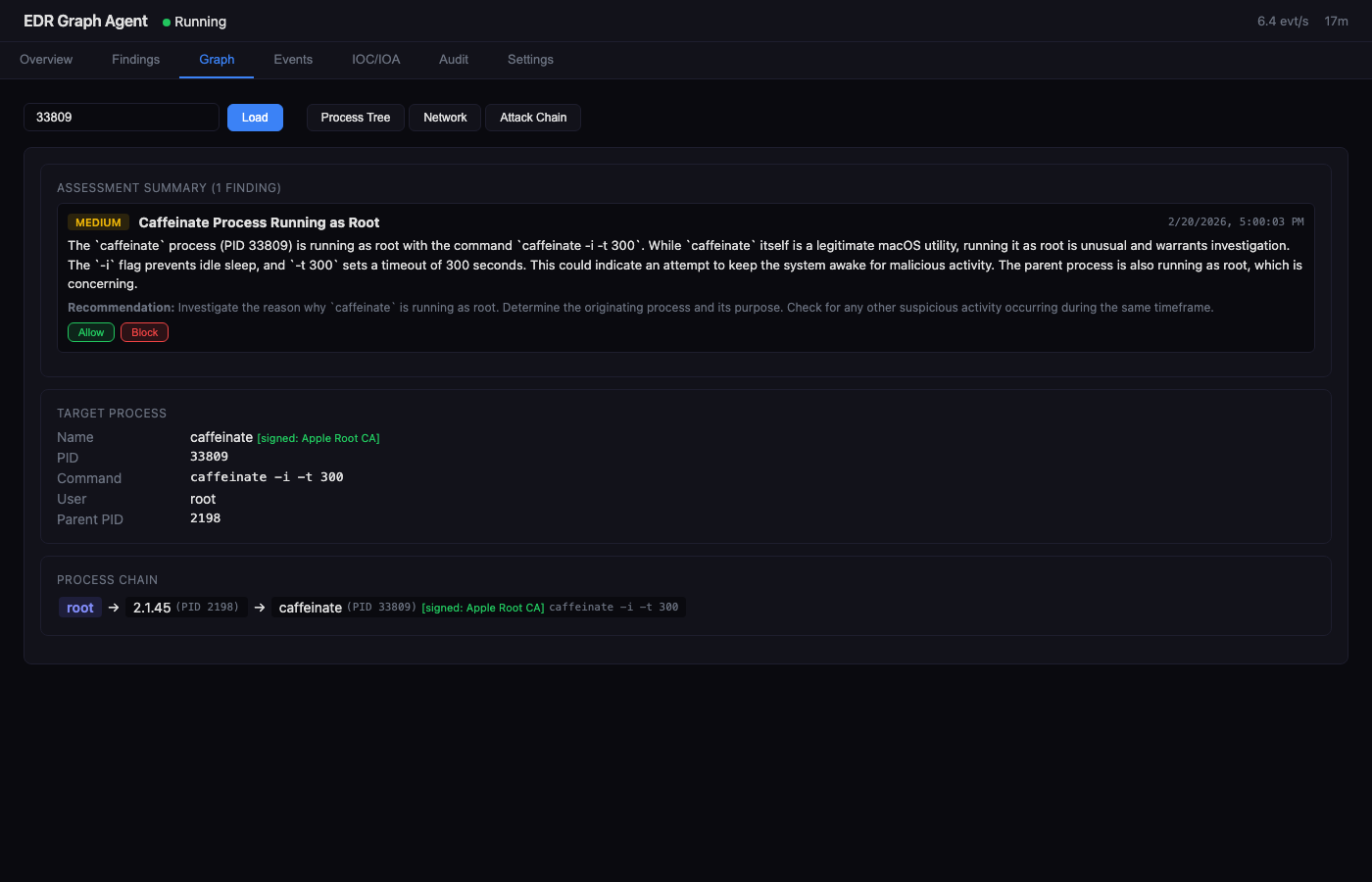
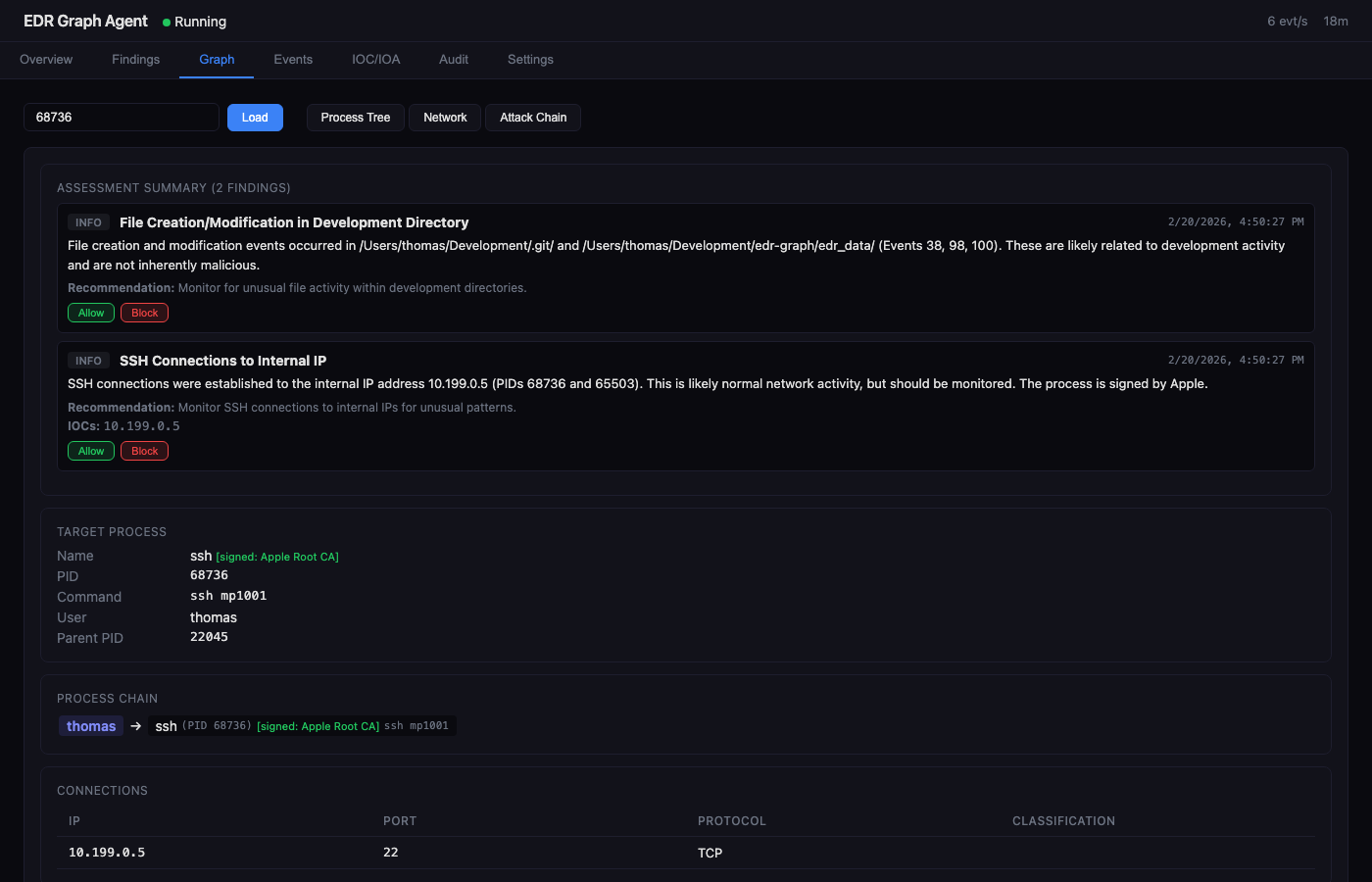
Stage 4: Filtering
Three filtering stages reduce noise before events reach the graph or the LLM.
For full details, see Filtering Pipeline & ROE.
Stage 4a — Agent Self-Filter: Events generated by the agent's own PID are suppressed.
Stage 4b — Pre-Graph Allowlist: High-volume, known-safe events are permanently dropped before graph insertion. Supports process_name, dst_ip, dst_cidr, domain, file_path rules. Chain context is NOT available at this stage.
Stage 4c — Baseline Graph Gating: In non-learning modes, edges that were observed during the learning phase are gated (not written to the graph), reducing graph size and LLM noise. Edge-level precision — individual relationships are gated, not entire events.
Warning
The Pre-Graph Allowlist permanently drops events. Do not put dual-use binaries (python, bash, curl) here — it will blind the EDR to all activity from those processes. Use this stage exclusively for deafening, harmless noise.
Stage 5: Graph Write Queue
Kuzu is a single-writer database. To safely handle concurrent writes from the processor and reaper threads, eDR-Graph uses an MPSC (multi-producer, single-consumer) write queue.
Architecture:
- All threads submit
WriteJobobjects to a thread-safe Python queue - A dedicated
graph-writerthread is the only thread that writes to Kuzu - Job types:
ENTITY_BATCH,IP_ENRICHMENT,PRUNE_EDGES,PRUNE_FULL,PURGE_BASELINE,PURGE_BY_RULE,SHUTDOWN - The
GraphBuildercreates a single Kuzu connection in the writer thread and performs all upserts
Entity batch writes use Kuzu's MERGE semantics — entities are created if new, or updated (last_seen timestamp) if they already exist.
Stage 6: LLM Analysis
The analyzer thread runs on a configurable interval (default: 60s) and investigates novel behaviors using an LLM with agentic tool use.
Preflight Novelty Filter
Before any event reaches the LLM, a preflight filter queries the Kuzu graph to check whether the behavior has been seen before:
- Process events — Has this process name been spawned more than N times?
- Network events — Has this process connected to this IP before?
- Auth events — Has this user authenticated from this source before?
If the graph edge count exceeds a configurable threshold (default: 5), the event is routine and is dropped. Only novel relationships pass through.
Result: In practice, ~1-5% of events reach the LLM, keeping API costs minimal.
Agentic Tool-Use Loop
The LLM (Gemma3-27B via DeepInfra) runs in an agentic tool-use loop with up to 5 iterations per analysis batch:
| Tier | Tool | Source |
|---|---|---|
| 1 | ip_geolocation |
Free API — country, ISP, ASN, proxy/hosting flags |
| 1 | reverse_dns |
Socket lookup |
| 1 | whois_lookup |
WHOIS registry |
| 2 | abuseipdb_check |
AbuseIPDB API (with graceful fallback) |
| 2 | virustotal_lookup |
VirusTotal API (with graceful fallback) |
| 3 | mitre_attack_lookup |
Local — bundled MITRE ATT&CK technique database |
| 3 | graph_context_query |
Local — query the Kuzu graph for entity relationships |
| 3 | lolbins_lookup |
Local — Living-off-the-Land binary detection |
Tool results within each analysis session are cached to avoid redundant API calls.
Finding Builder
The LLM produces structured findings with:
- Severity level (informational, low, medium, high, critical)
- MITRE ATT&CK technique mapping
- Attack chain reconstruction
- Affected entities and PIDs
- IOC extraction (IPs, domains, file hashes)
- Recommended response actions
Stage 7: Response Engine
The response engine maps findings to automated or supervised actions based on the current operating mode.
Three Operating Modes
| Mode | Behavior |
|---|---|
| Learning | Records all behaviors to a baseline. No alerts, no enforcement. |
| Passive | Generates findings and alerts (dashboard + tray). No enforcement. |
| Active | Full enforcement with baseline/allowlist/blocklist filtering and approval gates. |
8 Response Actions
| Action | Description | Platforms |
|---|---|---|
ALERT |
Dashboard + tray notification | All |
SUSPEND_PROCESS |
SIGSTOP / NtSuspendProcess | All |
TERMINATE_PROCESS |
SIGKILL / TerminateProcess | All |
ISOLATE_NETWORK |
Block all network for a PID | pf / iptables / netsh |
BLOCK_CONNECTION |
Block specific IP:port | pf / iptables / netsh |
QUARANTINE_FILE |
Move to quarantine, strip perms, chain of custody | All |
DNS_SINKHOLE |
Redirect domain to 127.0.0.1 | All |
PANIC_ISOLATE |
Emergency: block all network traffic | All |
Active Mode Evaluation Order
- Blocklist — Force-respond even if baselined (e.g., known C2 indicators)
- Allowlist — Skip response for known-good behaviors
- Baseline — Skip response for behaviors observed during learning
- Policy — Map severity to actions, check protected process list, request approval
Protected process list prevents the agent from terminating system-critical processes (launchd, csrss.exe, systemd, sshd, etc.) regardless of severity.
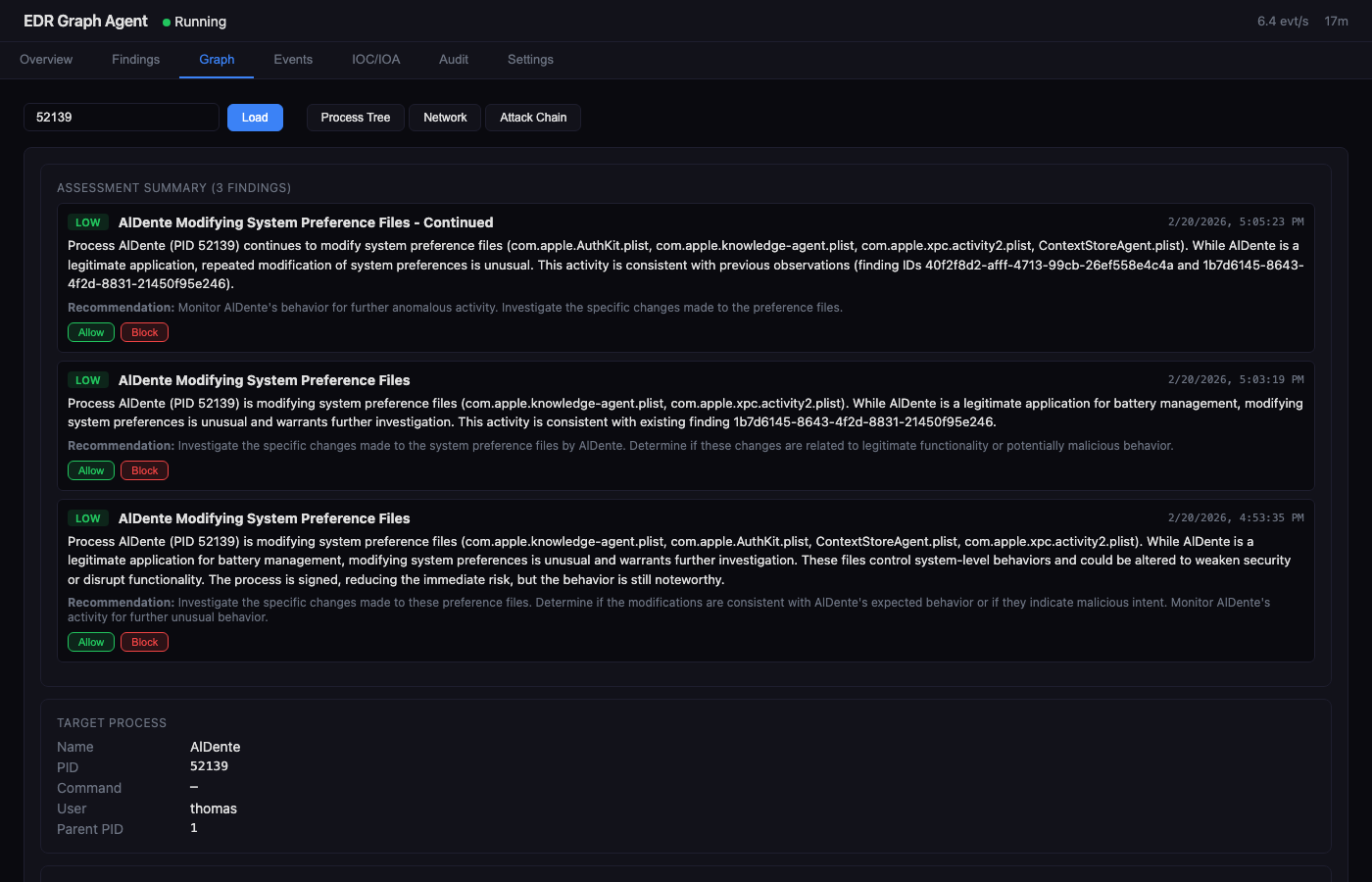
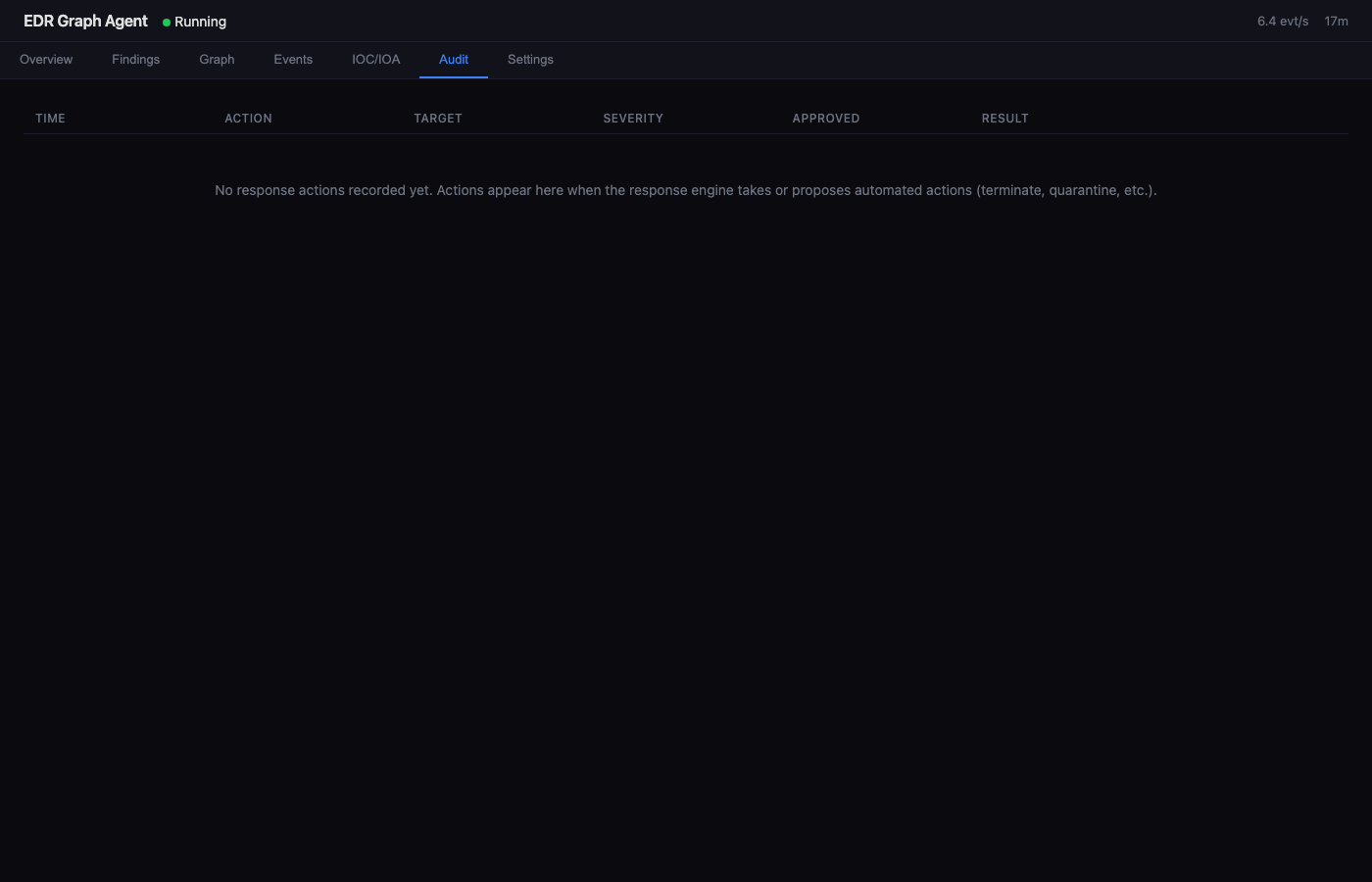
Thread Architecture
The agent runs 7+ daemon threads coordinated by a central shutdown event:
| Thread | Role |
|---|---|
collector |
Poll OS-native telemetry sources |
processor |
Normalize → extract → filter → submit to write queue |
graph-writer |
Single-writer Kuzu consumer (entity upserts, prune jobs) |
analyzer |
Periodic LLM analysis of novel events |
reaper |
Pressure-driven graph pruning (TTL-based, emergency thresholds) |
heartbeat |
Watchdog heartbeat writes |
ioc-download |
Background IOC feed refresh |
forwarder |
Fleet finding/event forwarding (optional) |
The main thread runs the macOS tray icon (if enabled) or blocks on the shutdown signal.
Entity Relationship Diagram
                    ┌──────────┐
                    │   User   │
                    │ id, name │
                    └────┬─────┘
                         │ SPAWNED
                         ▼
┌──────────┐      ┌──────────────┐      ┌─────────┐
│   File   │◀─────│   Process    │─────▶│   IP    │
│ path,    │ FILE │ name, pid,   │CONN  │ address,│
│ sha256   │ OPS  │ cmd_line,    │TO    │ country,│
└──────────┘      │ parent_pid,  │      │ isp     │
                  │ code_signed  │      └─────────┘
                  └──────┬───────┘
                         │ RESOLVED
                         ▼
               ┌──────────────────┐     ┌─────────┐
               │     Domain       │────▶│   IP    │
               │ name, tld,       │RES  │         │
               │ is_dga_candidate │TO   └─────────┘
               └──────────────────┘

                  ┌──────────────┐
                  │ RegistryKey  │◀── Process (REG OPS)
                  │ path, value  │
                  └──────────────┘